
Testing, Fabrication and Facilities
Under its mandate, the Centre investigates appropriate designs of solar and other renewable energy equipment and appliances for domestic, agricultural and industrial uses, and develops, produces and tests prototypes of the same. It also investigates the efficiencies of renewable energy systems with a view to developing more efficient ones.
The Centre’s laboratories, workshops, library and testing area are located on its old site within the main campus of Usmanu Danfodiyo University, Sokoto, while the administrative block, auditorium, staff offices and computer room are on the permanent site.
Services Unit — Fabrication
The Services Unit is responsible for the construction of all renewable energy systems developed by the research units of the Centre, using the Centre’s own workshop machinery, including power drilling and metalworking equipment.
Meteorological Testing Area
The testing area hosts the Wind and Meteorology Unit’s instrumentation, including a data logger station and local radiation sensors measuring direct and diffuse radiation.
Prototype Development and Testing
Systems are designed, fabricated and tested at prototype, pilot and large-scale level. Solar thermal systems in particular have been fabricated and tested to the level of commercialisation.
Small Hydropower Laboratory
The Small Hydropower Unit maintains a laboratory for research, testing and demonstration, including a laboratory-simulated model of a hydro-electric power plant.
ICT Facilities
ICT equipment is provided across both sites, including an access laboratory, internet access, projectors and scanners, supported by a VSAT and a radio-frequency wireless network.
Demonstration Areas
Dedicated demonstration rooms and outdoor areas allow the Centre’s biomass, solar thermal, solar PV and hydropower systems to be shown to visitors, students and community groups.
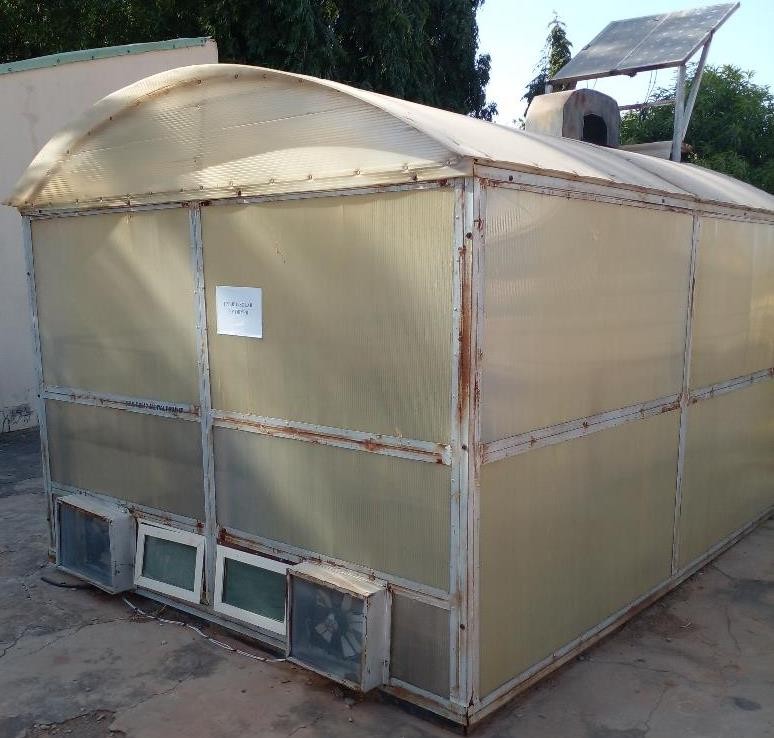
From Prototype to Patent
The Centre’s hybrid active and passive large-scale solar dryer — developed for drying crops and jerky meat (“kilishi”) — illustrates the full path from design through fabrication and testing. Built with Perspex glazing and PV-powered air blowers, it can operate by natural or forced convection and can be expanded for large-scale agricultural and industrial use.
This dryer has been patented.